

VR Gaming: The Future of Immersive Entertainment Is Already Here
Something shifts the moment you put on a VR headset for the first time. It's not just a bigger screen or louder audio. The game is around you. You reach out instinctively, forgetting for a second that your hand will pass through nothing. That moment of forgetting — that's what makes virtual reality gaming unlike anything else in entertainment history.
VR gaming has moved well past the "tech demo" phase. Real games, real communities, and real emotional experiences are happening inside headsets right now. The question isn't whether VR is interesting anymore. It's how fast it's going to reshape everything we thought we knew about interactive entertainment.
What Makes VR Gaming Truly Immersive
VR gaming delivers immersion by replacing your entire visual field with a responsive virtual environment, triggering spatial instincts that flat screens simply cannot reach. Traditional gaming asks you to watch a character move through a world. VR puts you inside it.
The difference comes down to presence — the psychological sensation of actually being somewhere. When your head turns and the virtual world turns with it, your brain starts treating that space as real. This is why people duck when something flies at them in VR, or feel genuine vertigo standing on a virtual ledge.
Motion tracking and hand controllers are central to this effect. When your physical gestures translate directly into the game — drawing a bow, deflecting a sword, or painting on a virtual canvas — the loop between intention and action collapses. You stop thinking about button inputs and start just doing things.
This is a fundamentally different cognitive experience than controller-based gaming. And it opens doors to genres and interactions that flat-screen gaming can't replicate: physical puzzle-solving, embodied combat, spatial exploration, and performance-based rhythm games that feel like actual dancing.
The Current State of VR Gaming — Where We Stand Today
VR gaming has split into two main hardware categories — standalone headsets and PC-tethered systems — and both have matured significantly in the past few years. Standalone devices offer wireless freedom and simple setup, making them the entry point for most new users. Tethered systems, connected to high-performance PCs, push visual fidelity and processing power to their limits.
Mainstream adoption has grown steadily, driven largely by standalone headsets that removed the need for expensive gaming rigs. The library of available games has expanded across genres — action, horror, social simulation, fitness, and narrative experiences all have strong VR entries now.
Popular genres have found natural fits in VR. Rhythm games benefit from full-body engagement. Horror games exploit spatial audio and peripheral vision in ways that feel genuinely threatening. First-person shooters become more physical and intuitive. Even slower-paced exploration games take on new depth when you can physically lean in to examine details.
The gap between "early adopter toy" and "mainstream gaming platform" is narrowing. VR gaming isn't dominant yet, but it's no longer fringe either.
Key Technologies Driving VR Forward
Several hardware and software advances are closing the distance between virtual environments and physical reality, making immersive gaming experiences more convincing and comfortable than ever before.
Haptic feedback technology is one of the most exciting frontiers. Early VR controllers offered basic rumble. Newer haptic systems can simulate texture, resistance, and impact — letting you feel the difference between gripping a rope and catching a ball. Haptic gloves and vests are moving from research labs toward consumer availability, and when they arrive broadly, they'll add a sensory layer that changes everything about presence.
Display resolution has improved dramatically. Higher pixel density eliminates the "screen door effect" that made early headsets feel like looking through a mesh. Combined with wider fields of view and faster refresh rates, modern displays reduce eye strain and make virtual environments feel more continuous and real.
Eye tracking is another leap forward. When a headset knows exactly where you're looking, it can render the highest detail precisely where your gaze falls — a technique called foveated rendering. This allows visually rich environments without the processing cost of rendering everything at maximum quality simultaneously.
On the software side, game engines and VR development tools have matured. Developers can build complex VR worlds faster, which means a broader and better content library is coming. AI-driven environments — where NPCs respond intelligently to your behavior and spaces adapt dynamically — are beginning to appear in experimental titles.
Social and Multiplayer VR — Gaming Together in Virtual Worlds
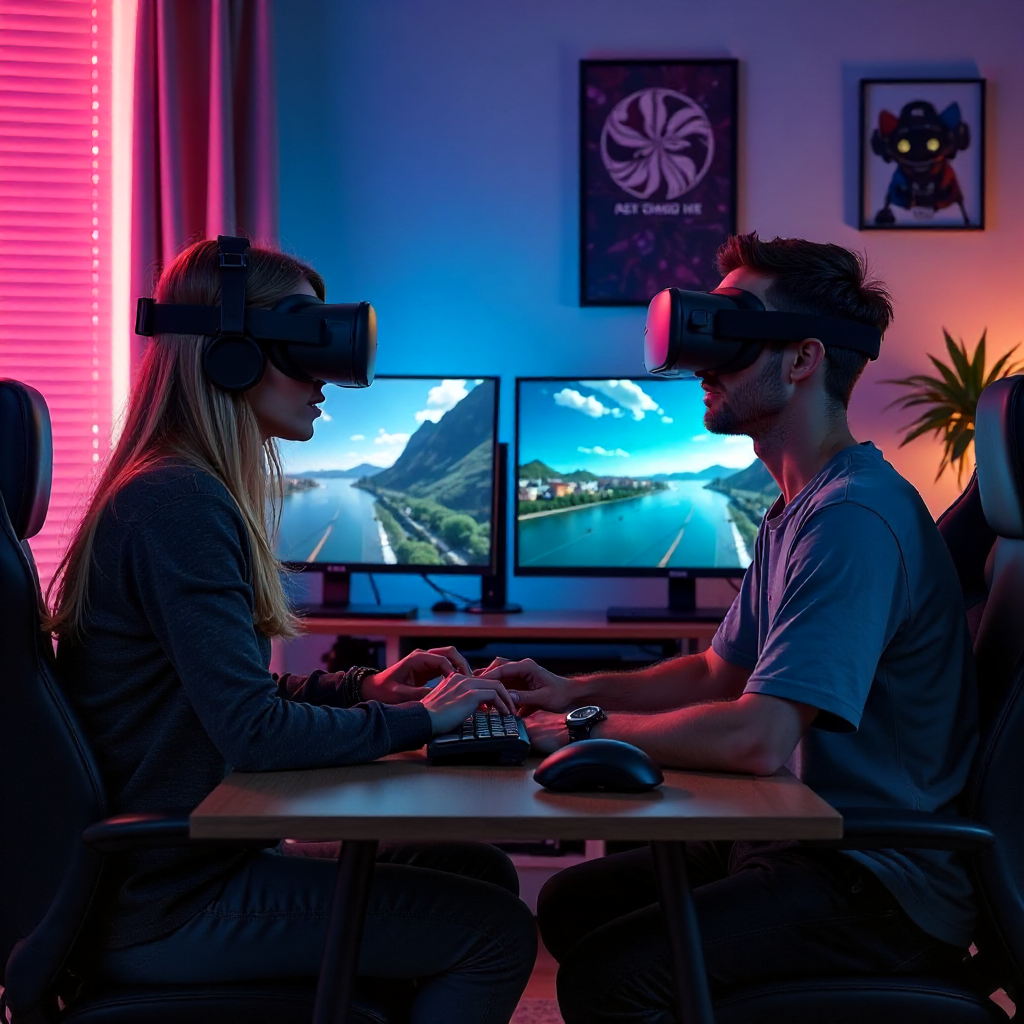
Shared VR spaces are redefining what online multiplayer feels like, turning gaming sessions into something closer to actual social gatherings. When you can see a friend's avatar gesture, hear their voice from the right direction in 3D space, and interact with objects together, the experience stops feeling like a game lobby and starts feeling like a place.
Social VR platforms have built communities around virtual concerts, game nights, creative collaboration, and casual hangouts. These aren't just games — they're entertainment venues. The line between "playing a game" and "spending time with people" blurs in ways that traditional online gaming never quite achieved.
This is where the metaverse concept finds its most tangible expression. Not as a corporate pitch, but as something people actually feel: a shared virtual world where identity, community, and entertainment overlap. Multiplayer VR experiences — from cooperative escape rooms to massive virtual arenas — hint at what persistent virtual worlds could become as hardware improves and user bases grow.
The social dimension also changes how games are designed. Developers are building experiences around communication, physical presence, and shared goals in ways that translate poorly to flat screens but feel completely natural in VR.
Challenges Holding VR Back (and How They're Being Solved)
VR gaming faces real barriers — cost, motion sickness, limited physical space, and content depth — but each of these is being actively addressed by the industry. Acknowledging them honestly is important, because overpromising on VR has historically damaged its credibility.
Hardware affordability remains the biggest hurdle. Quality VR headsets still represent a significant purchase for most people. However, prices have dropped considerably, and standalone options have made entry-level VR accessible without requiring a high-end PC. The trajectory points toward continued price reduction as manufacturing scales.
Motion sickness affects a meaningful percentage of users, particularly in games with artificial locomotion — moving through virtual space without physically walking. The industry has responded with multiple comfort options: teleportation movement, reduced field of view during fast movement, and better frame rate stability. Many users also find their sensitivity decreases with gradual exposure over time.
Physical space requirements create a real-world constraint. Room-scale VR needs clear floor space, which isn't available to everyone. Developers have responded by designing more seated or stationary experiences, and some headsets now handle boundary detection automatically to work in smaller areas.
The content library, while growing, still has gaps compared to traditional gaming platforms. But the pace of development is accelerating. As the user base expands, commercial incentives for developers increase — a cycle that tends to compound quickly once it reaches critical mass.
What the Next Five Years Could Look Like for VR Gaming
The next phase of VR gaming will likely be defined by hardware that disappears — lighter, more comfortable headsets that feel closer to glasses than goggles, combined with environments that feel less constructed and more alive.
Mixed reality and extended reality (XR) capabilities are being integrated into VR headsets, allowing virtual elements to overlay and interact with real physical spaces. This blurs the boundary between gaming and everyday life in ways that could make VR a persistent part of the home environment rather than a dedicated activity.
AI-driven game worlds represent perhaps the most transformative near-term development. Environments that respond intelligently to player behavior, NPCs with genuine conversational depth, and procedurally generated narratives that feel authored — these are moving from experimental to practical. The result will be VR experiences with a lifespan and replayability that current titles can't match.
Broader game libraries, better social infrastructure, and improved VR accessibility tools for players with disabilities are all in active development. The overall direction is clear: VR gaming is becoming more inclusive, more social, and more deeply integrated into mainstream entertainment culture.
Is Now the Right Time to Jump Into VR Gaming?
For most gaming enthusiasts, now is a genuinely good time to enter VR — not a perfect time, but a good one. The hardware is capable, the content library has enough depth to justify the investment, and the experience quality is high enough that it won't feel like a compromise.
The honest trade-off: buying in now means accepting that better hardware is coming. The headset you purchase today will likely be outperformed by what's available in two or three years. But waiting indefinitely means missing experiences that are available and excellent right now.
If you're primarily drawn to social gaming, multiplayer experiences, or physical/fitness-oriented games, VR delivers immediate, distinctive value. If your main interest is story-driven, graphics-intensive AAA titles, the library is growing but still thinner than traditional platforms.
The sweet spot for jumping in: if you have the physical space, a budget that accommodates a mid-range headset, and genuine curiosity about a new mode of play. That combination makes the investment worthwhile today, not as a bet on the future, but as access to something that's already genuinely different from anything else in gaming.
Frequently Asked Questions
What is the difference between VR, AR, and MR in gaming?
Virtual reality (VR) replaces your entire visual field with a digital environment. Augmented reality (AR) overlays digital elements onto the real world, visible through a phone or transparent lens. Mixed reality (MR) goes further — virtual objects interact with real physical surfaces and can be occluded by real-world items. In gaming, VR offers the deepest immersion, while AR and MR blend virtual content with your actual surroundings.
Do you need a powerful PC to play VR games?
Not necessarily. Standalone VR headsets run games using their own built-in processors, requiring no PC at all. PC-tethered headsets do require a capable gaming computer, but standalone options have made high-quality VR gaming accessible without additional hardware investment beyond the headset itself.
How do you prevent motion sickness in VR gaming?
Start with shorter sessions and games that use teleportation or stationary movement rather than joystick locomotion. Good frame rate stability matters — if a game runs poorly, discomfort increases. Many users find their sensitivity decreases after gradual exposure over several sessions. Choosing comfort-mode settings in games, which often reduce field of view during fast movement, helps significantly.
Are there enough good VR games to justify buying a headset?
Yes, for most player types. The library includes standout titles across rhythm, action, horror, fitness, and social genres. The selection isn't as broad as traditional platforms, but there's enough quality content to provide genuine value — especially if you're drawn to genres that translate particularly well to VR's physical, spatial format.
Will VR gaming eventually replace traditional console and PC gaming?
Replacement is unlikely in the near term. VR gaming offers a distinct experience rather than a strictly superior one — it requires physical space, active engagement, and hardware that not everyone wants to wear. The more probable outcome is that VR becomes a significant, mainstream entertainment category alongside traditional gaming rather than instead of it.